Bernie Sanders scored an impressive victory in the New Hampshire Democratic Primary last night, racking up a colossal 60% of the vote to Hillary Clinton’s 38%. And while a Bernie win here is not a huge surprise, this margin of victory (+22) is significantly greater than the run-up polling predicted. He also won among Clinton’s target demographic groups like women and moderates. So Bernie voters understandably see the New Hampshire results as a ray of hope for the “revolution” platform.
Hillary won the delegate count
But if we step back from the raw vote percentages, it’s clear that the bigger winner was actually Hillary Clinton– for two main reasons. First, by virtue of a quirk in the primary system, Clinton ends up getting more DNC delegates from New Hampshire than Bernie does. This is because New Hampshire’s delegation to the DNC includes 8 so-called super-delegates, party officials who are free to vote for whomever they favor regardless of the popular vote in New Hampshire. Six of the eight super-delegates have pledged to support Clinton, while the other two remain uncommitted. Thus, despite a smashing win in the New Hampshire popular vote, Bernie claims only 13 of the state’s delegates to Hillary’s 15 – per CNN. And of course it’s the delegates that ultimately matter for the purposes of winning the nomination!
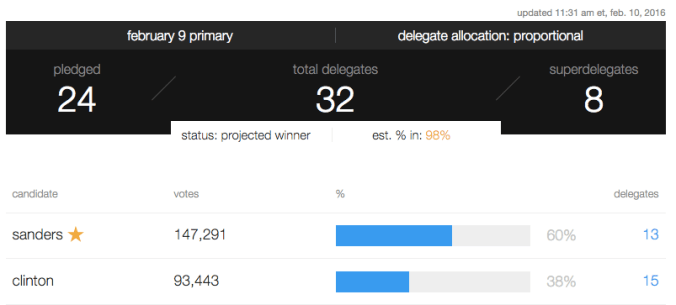
So despite Bernie’s great achievement, Hillary – smooth operator that she is – still comes out ahead in the race for the Democratic nomination. And in the upcoming primaries in states like Nevada, South Carolina, and several other southern states, Clinton faces a much more congenial electorate. If Bernie can’t win the delegate tally in independent-minded, heavily white New Hampshire, it’s not clear that he has much of a shot at taking down the Clinton operation in the long haul of the primaries.
Hillary’s GOP opposition just got downgraded
The second reason New Hampshire was a win for Hillary is arguably more important: it shows that the GOP is in shambles. After Rubiobot’s meltdown in Saturday’s debate, the so-called establishment lane of the GOP race went into chaos, with John Kasich emerging as the second place finisher in New Hampshire behind anti-establishment firebrand Trump.
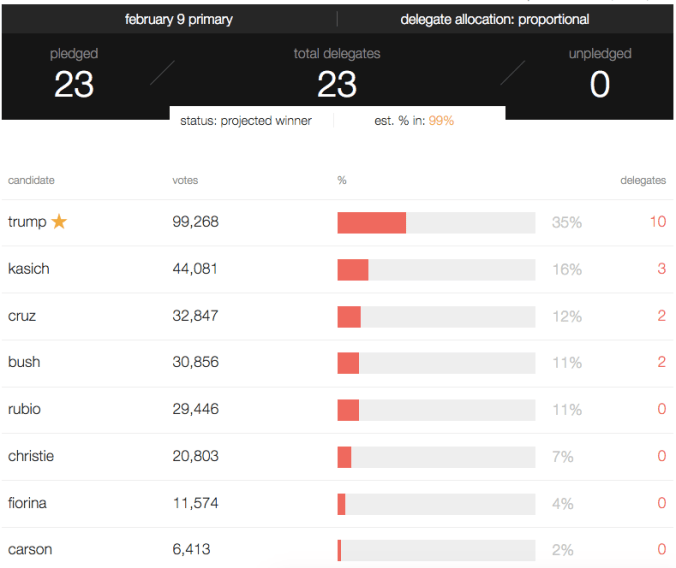
The problem for the GOP establishment/centrist bloc is that their support continues to be fragmented among Kasich, Rubio, Bush, and Christie. After Iowa it seemed that Rubio might emerge as the champion of this bloc who could challenge Trump and the more hard-right candidate Cruz. But with Rubio tumbling down to a sluggish fifth place finish, it seems more likely than ever the establishment will fail to unite, allowing Trump to divide and conquer and build unstoppable momentum as we head into the heart of primary season.
This is great news for Hillary. Trump has a net favorability rating of -20, and he fares poorly in head-to-head polls against Hillary. By comparison Rubio’s net favorables are -3.5 and he has the best head-to-head ratings against Hillary of any GOP candidate. (For reference, Hillary’s net favorability is around -11.) So Hillary should be delighted to see Trump rather than Rubio emerging as her likely opponent in the general election.
So I’d argue that for Hillary the most significant result of New Hampshire was neither losing the popular vote nor winning the delegate count but rather watching her most dangerous rival on the GOP side fade to the middle of the pack.
 CORTEX
Pingback: Superdelegates Don’t Count. Not Yet. | CORTEX