Run to Stop Cancer

This is not a fundraiser. “Run to stop cancer” is scientifically sound advice.

Unlike diabetes and coronary disease, which predictably prey upon the overweight and out-of-shape, cancer may seem to strike out of the blue, affecting the young and healthy as well as the wanton. And since cancer is fundamentally a genetic disease, it’s easy to feel helpless to combat a potential death sentence inscribed in your DNA.

But as Aaron Carroll points out, science is showing that genes alone do not account for even half of all cancer risk:

Using sophisticated modeling techniques, the researchers argued that less than 30 percent of the lifetime risk of getting cancer was because of intrinsic risk factors, or “bad luck.” (NYT/Nature)

Another study from JAMA Oncology found that 25% of cancers in women and 33% in men were potentially preventable by lifestyle modification: smoking cessation, moderation of alcohol intake, maintenance of healthy body weight, and regular exercise.

So lifestyle choices like diet and exercise seem to play as big a role as genetics in moderating cancer risk at the population level. There are individual cases where genetic mutations wholly predetermine cancer occurrence, but the vast majority of cancer types have a lifestyle-risk element. This should be a message of empowerment. Cancer is not destiny; we can and should use our powerful tools of lifestyle change to prevent cancer before it happens.

For details on the adrenalin theory of how exercise fights cancer, check out this piece in The Economist.
Top 10: The Best Songs From Hamilton

6358021610526848122095891113_tjLin-Manuel Miranda’s Hamilton will go down as one of the major artistic achievements of the decade (century?) The combination of subject matter (the Founding of the nation), social significance (a non-white cast and composer telling the story of our all-white Founding Fathers), and theatrical greatness (a mix of hip-hop and more traditional numbers) make Hamilton a work that should survive in public consciousness for as long as the United States is a nation – and maybe longer.  Here are some of the highlights:
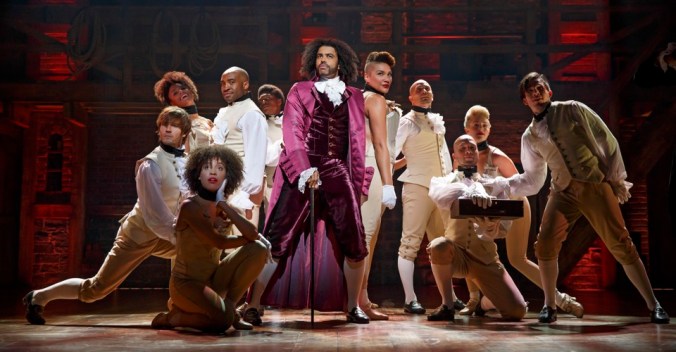
10. Cabinet Battle #1: Thomas Jefferson vs. Alexander Hamilton in a rap battle representing the nation’s first major political rivalry. Hamilton (Miranda) goes for the throat:

A civics lesson from a slaver. Hey neighbor
Your debts are paid cuz you don’t pay for labor
“We plant seeds in the South. We create.”
Yeah, keep ranting
We know who’s really doing the planting

9. My Shot: An early energy and character builder for the boyish Alexander: Yo I’m just like my country/ I’m young, scrappy, and hungry/ and I’m not throwin’ away my shot.

8. You’ll Be Back: King George (Jonathan Groff ) reigns as the petulant monarch pining for his wayward love, the American colonies, to return to him: When push comes to shove/ I will kill your friends and family/ To remind you of my love.

7. Burn: An appropriately named slow burner. The plaintive violin line gives it a Funeral-era Arcade Fire feel.

6. Alexander Hamilton: The iconic opener introduces the voices of a terrific cast and provides a whirlwind tour through the youth of America’s supreme “bastard, orphan, son of a whore.”

5. History Has Its Eyes On You / Who Lives, Who Dies, Who Tells Your Story: George Washington (Christopher Jackson {what a voice}) waxes eloquent on the Founders’ burden of legacy building in “History.” “Who Lives” picks up the melodic and thematic strand in a stirring closer; its only flaw is the perhaps excessive exposition at the expense of lyrical flow.

4. Guns and Ships: History has never been more fun than the motor-mouthed French-accented rapping by Daveed Diggs. Also a reason why it makes little sense to see this show live without listening ahead of time. No way your ears can keep up with his tongue twisters.

3. Wait For It: High school history books portray Aaron Burr as a bit of a nut. But Miranda turns Hamilton’s ultimate enemy into a compelling and sympathetic foil. Played by Leslie Odom, Jr., Burr gets some of the play’s most memorable lines. And Miranda’s powerful use of the chorus heightens the emotion.

2. Say No To This: The sultry Maria Reynolds (Jasmine Cephas Jones) nails the show’s musical climax with her “STAAAAAY.” The harp glissandos in the chorus give me tingles.

1. Satisfied: A wedding toast warps into a flashback: a love story fraught by jealousy, restlessness, and familial duty. The frustrations of 18th century gender dynamics find expression in Renee Elise Goldsberry’s doubly impressive performance as rapper and balladeer.

Trump’s Health Care Plan Is One Sentence Plus Hand Gestures

Screen Shot 2016-02-27 at 2.47.30 PM.png

Obamacare, whatever its flaws, has extended insurance coverage to an estimated 16 million people.  Donald Trump promises to repeal it and in return offers no direct support for poor and middle class families who struggle with health costs. His sole substantive proposal on health care is to deregulate insurance companies to make it easier for them to sell insurance across state lines.

Trump summed up his plan in the debate on Thursday: “When you get rid of the lines [around the states] it brings in competition.” Circular hand motions were added to make the point more vivid.

There are two major problems with this proposal: (1) it doesn’t work, and (2) even if it did, it’s nothing close to a complete health care plan for the nation.

In theory driving down costs by encouraging interstate competition is a nice free-market idea. But as the Upshot has detailed, the evidence that this works in practice is nil:

The trouble is that varying or numerous state regulations aren’t the main reason insurance markets tend to be uncompetitive. Selling insurance in a new region or state takes more than just getting a license and including all the locally required benefits. It also involves setting up favorable contracts with doctors and hospitals so that customers will be able to get access to health care. Establishing those networks of health care providers can be hard for new market entrants….

In 2012, Ms. Corlette and co-authors completed a study of a number of states that passed laws to allow out-of-state insurance sales. Not a single out-of-state insurer had taken them up on the offer. As Ms. Corlette’s paper highlighted, there is no federal impediment to across-state-lines arrangements.

The laborious work of setting up a network of providers is not something that out-of-state insurers can easily replicate, and as far as the evidence goes, there’s no sign it would have any effect on the insurance market or costs to consumers.

Even if eliminating state barriers somehow restrained growth in health care costs, repealing Obamacare would toss 10 million+ back into the realm of the uninsured. What would happen to people with pre-existing conditions? That Trump hasn’t even thought about addressing these issues highlights how shallow his approach to policy is. After eight months of running for president all he’s picked up on health care is an irrelevant sound bite on “lines around states.”

In the clip below, when Dana Bash asked Trump if he has any other health policy ideas to add, Trump responded: “There’s nothing to add. What’s to add?” Meanwhile his odds of winning the GOP nomination are approaching 80%.

How Clinton Won Big in New Hampshire Despite Her Huge Loss to Bernie

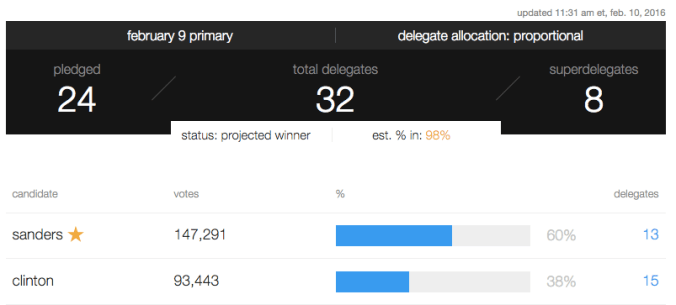
Bernie Sanders scored an impressive victory in the New Hampshire Democratic Primary last night, racking up a colossal 60% of the vote to Hillary Clinton’s 38%. And while a Bernie win here is not a huge surprise, this margin of victory (+22) is significantly greater than the run-up polling predicted. He also won among Clinton’s target demographic groups like women and moderates. So Bernie voters understandably see the New Hampshire results as a ray of hope for the “revolution” platform.

Hillary won the delegate count

But if we step back from the raw vote percentages, it’s clear that the bigger winner was actually Hillary Clinton– for two main reasons. First, by virtue of a quirk in the primary system, Clinton ends up getting more DNC delegates from New Hampshire than Bernie does. This is because New Hampshire’s delegation to the DNC includes 8 so-called super-delegates, party officials who are free to vote for whomever they favor regardless of the popular vote in New Hampshire. Six of the eight super-delegates have pledged to support Clinton, while the other two remain uncommitted. Thus, despite a smashing win in the New Hampshire popular vote, Bernie claims only 13 of the state’s delegates to Hillary’s 15 – per CNN. And of course it’s the delegates that ultimately matter for the purposes of winning the nomination!

Screen Shot 2016-02-10 at 11.36.06 AM.png

So despite Bernie’s great achievement, Hillary – smooth operator that she is – still comes out ahead in the race for the Democratic nomination. And in the upcoming primaries in states like Nevada, South Carolina, and several other southern states, Clinton faces a much more congenial electorate. If Bernie can’t win the delegate tally in independent-minded, heavily white New Hampshire, it’s not clear that he has much of a shot at taking down the Clinton operation in the long haul of the primaries.

Hillary’s GOP opposition just got downgraded

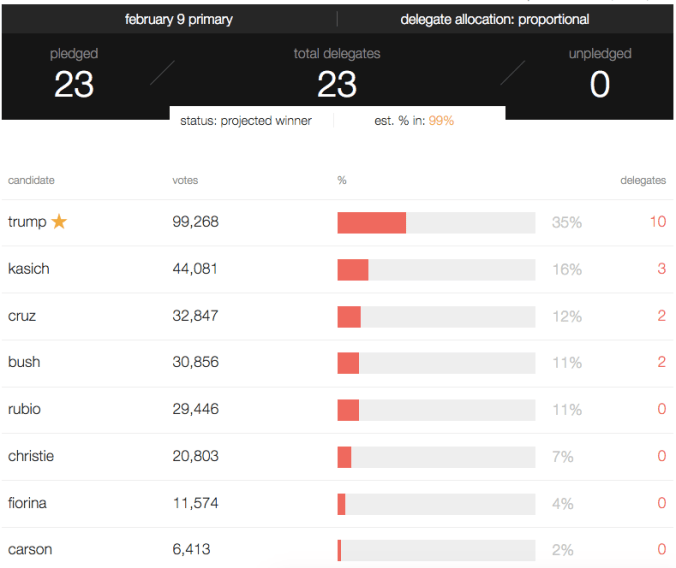
The second reason New Hampshire was a win for Hillary is arguably more important: it shows that the GOP is in shambles. After Rubiobot’s meltdown in Saturday’s debate, the so-called establishment lane of the GOP race went into chaos, with John Kasich emerging as the second place finisher in New Hampshire behind anti-establishment firebrand Trump.

Screen Shot 2016-02-10 at 11.57.11 AM.png

The problem for the GOP establishment/centrist bloc is that their support continues to be fragmented among Kasich, Rubio, Bush, and Christie. After Iowa it seemed that Rubio might emerge as the champion of this bloc who could challenge Trump and the more hard-right candidate Cruz. But with Rubio tumbling down to a sluggish fifth place finish, it seems more likely than ever the establishment will fail to unite, allowing Trump to divide and conquer and build unstoppable momentum as we head into the heart of primary season.

This is great news for Hillary. Trump has a net favorability rating of -20, and he fares poorly in head-to-head polls against Hillary. By comparison Rubio’s net favorables are -3.5 and he has the best head-to-head ratings against Hillary of any GOP candidate. (For reference, Hillary’s net favorability is around -11.) So Hillary should be delighted to see Trump rather than Rubio emerging as her likely opponent in the general election.

So I’d argue that for Hillary the most significant result of New Hampshire  was neither losing the popular vote nor winning the delegate count but rather watching her most dangerous rival on the GOP side fade to the middle of the pack.

New Hampshire Predictions: In the Wake of Rubiobot

Marco Rubio emerged from Iowa as the momentum candidate in the GOP. His strong third place finish put him close to Trump and decisively ahead of his “establishment” rivals: Bush, Kasich, and Christie. But then came Saturday’s debate and Rubio’s repetition gaffe:

Polls leading up to Saturday’s debate showed Rubio building toward a strong second place showing and another decisive win over his establishment peers, but now Rubio’s stock is dipping back toward the rest of the pack’s. Christie was eager to take down Rubio at the debate, but he came off looking like a bully and probably won’t get much of a bounce out of it. So the immediate beneficiaries of the Rubiobot moment are likely to be the other establishment lane figures: Kasich and Bush. With that in mind, it’s time for predictions for the GOP New Hampshire primary:

Trump: 32  Kasich: 15  Rubio: 14  Cruz: 12  Bush: 12 Christie: 8 Fiorina: 4  Carson: 2

If this plays out, the big picture winner here is also the immediate: Trump. Not only does Trump claim the lion’s share of the delegates but he also benefits from seeing an establishment lane that continues to be fractured and in flux. Will party elites rally around Kasich if he wins? Seems unlikely. But one could imagine them being slower to unify behind Rubio. Meanwhile unless Bush or Christie surprise, they will not have done enough to justify party confidence and might even need to think about exiting the race. If establishment support continues to be splintered among several candidates, Trump’s position will remain relatively strong as the campaign moves into the Southern states.

The Democratic side is much less intriguing in the Granite State. Expect a handy but not race-changing win for Bernie:

Sanders: 54  Clinton: 44

Flint’s Lead Crisis & The Coming Crime Wave

In the wake of Flint, Michigan’s water crisis (check out this timeline for details), it’s worth noting why lead poisoning is so awful not only for the individual families affected but also for the wider community. Kevin Drum’s 2013 reporting on lead as a driver of crime is more important than ever. His work illustrated that rising lead emission was tightly correlated with the crime spike of the 1960s-80s and that declining emissions were tied to falling crime in the 1990s-present:

In a 2000 paper (PDF) [researcher Rick] Nevin concluded that if you add a lag time of 23 years, lead emissions from automobiles explain 90 percent of the variation in violent crime in America. Toddlers who ingested high levels of lead in the ’40s and ’50s really were more likely to become violent criminals in the ’60s, ’70s, and ’80s.

Screen Shot 2016-02-07 at 12.06.26 PM

Similar correlations hold when the data is analyzed at local levels or across countries. Meanwhile neuroscience research has provided a better understanding of what lead does to the brain:

As [public health professor] Reyes summarized the evidence in her paper, even moderately high levels of lead exposure are associated with aggressivity, impulsivity, ADHD, and lower IQ. And right there, you’ve practically defined the profile of a violent young offender.

It’s not hard to connect the dots: lead addles the brain, and the addled brain is prone to crime. Which means that the Flint water crisis of 2014-2016 is not a self-contained fiasco. The water crisis is a lead crisis and thus it plants the seeds for a potential crime crisis in the 2020s and 2030s. For a city that’s already among the nation’s most dangerous, it’s insult to injury.

Food Fight

Every five years the USDA and HHS release updated dietary guidelines for Americans, and the latest version, Dietary Guidelines 2015-2020, just landed last week. According to the Executive Summary, the new guidelines represent a shift in philosophy:

Previous editions of the Dietary Guidelines focused primarily on individual dietary components such as food groups and nutrients. However, people do not eat food groups and nutrients in isolation but rather in combination, and the totality of the diet forms an overall eating pattern.

As a result, eating patterns and their food and nutrient characteristics are a focus of the recommendations in the 2015-2020 Dietary Guidelines.

The good thing about this move is that it (theoretically) shifts us away from inscrutable nutrient-talk. “Increase your ratio of unsaturated fat” or “eat nutrient-dense food” is food advice that only a nutrition professional could love.  Ditching the nutrient jargon should make the guidelines much more user-friendly.

But the new focus on “eating patterns” has its own pitfalls. The document’s five core Guidelines focus on eating patterns but are so vague that they verge on vapid: “#1: Follow a healthy eating pattern across the lifespan; #3: Shift to healthier food and beverage choices. #5: Support healthy eating patterns for all.”  So the USDA’s healthy eating advice is to eat healthier food. Got it…. Thankfully, the document’s Key Recommendations put a little more meat on the bones of the core Guidelines:

A healthy eating pattern includes:[1]

  • A variety of vegetables from all of the subgroups—dark green, red and orange, legumes (beans and peas), starchy, and other
  • Fruits, especially whole fruits
  • Grains, at least half of which are whole grains
  • Fat-free or low-fat dairy, including milk, yogurt, cheese, and/or fortified soy beverages
  • A variety of protein foods, including seafood, lean meats and poultry, eggs, legumes (beans and peas), and nuts, seeds, and soy products
  • Oils

A healthy eating pattern limits:

  • Saturated fats and trans fats, added sugars, and sodium

Hey, there’s some usable information in there! Notice that it’s the emphasis on foods – not mysterious nutrients or amorphous “eating patterns” – that makes this section at least partially usable for the lay reader.

But nutrition guru Marion Nestle points out a striking pattern in these recommendations: the Guidelines focus on foods when they suggest “eat more.”  But they revert to nutrient-talk when they suggest “eat less.” So “eat less saturated fat” serves as a euphemism for “eat less meat.” And “consume less sugar” replaces “drink less soda.”

Why the reversion to jargon when it comes to cutting out bad stuff? This is the political influence of food lobbyists at work. While a panel of scientific experts formulates findings and passes them on to the USDA, the USDA’s Guidelines are ultimately subject to extensive feedback and commentary from the public – chiefly the food industry that pours millions of dollars into lobbying efforts to shape the Guidelines. Here the USDA and HHS are subject to what political scientists call “regulatory capture.” Vox notes that this process can severely distort the government’s dietary advice:

Back in the 1980s, for instance, scientists were finding that saturated fats could be harmful to the body. Meat is a key source of saturated fat. But the meat industry didn’t want the government telling people to cut back. So after much lobbying, the official dietary guidelines settled on the message that we should all “eat less fat.” That actually distorted the science, since unsaturated fats are perfectly fine — and the sugar-laden, low-fat craze that followed turned out to be a disaster for public health.

So despite the Guidelines’ self-proclaimed move toward user-friendliness, the new Guidelines fall into two major traps. On one hand they aim for lofty and non-specific goals about forging new “eating patterns.” On the other hand, under pressure from industry they fall into the old trap of micro-targeting nutrients in a way that is likely to be perplexing to the average American. The right course is intermediate between these two pitfalls –  dietary guidelines should center squarely on the foods that people know and consume every day.