American Exceptionalism and the 2016 Presidential Election

To chime in on the Hillary-Bernie debate, I just want to say I wholeheartedly support Bernie Sanders’ campaign. He speaks to my heart and what I want for all people in the United States and the World: harmony, freedom, love, compassion, equality, fairness. If I voted with my heart, I would vote for Bernie. I will, however, be voting with my finger; punching through a hanging chad waiting for it to fall to the ground before rejoicing like all Jewish grandmothers across South Florida (I mean my nice neighbors down by the beach.)

Just kidding. This election cycle, I will vote with my head. And in the upcoming Democratic Primary, I’m voting for Hillary. She represents what is great about America. Power, Opportunity, Optimism, and Freedom (though perhaps this one slightly less so than Bernie, I must admit). What’s more she represents what is exceptional about America, and what has, ironically, taken somewhat of a back step during the era of Obama: Diversity.

Her recent pledge to end racism with a $125 billion budget speaks to the transcendence of her candidacy. With her politicking ability, she also represents the most uninterrupted path forward for our country’s less fortunate. Her candidacy is the only logical progression of the Obama presidency, by all sane measures, a success. She is the single most qualified candidate in the entire field for the position and could wield a mighty, yet gentle sword for goodness of our country and our world.

Right now, however, I am less than optimistic about her ability to win the election given the latest trajectory of the national polls. She may have all the ability and connections in the world to bring politicians and lobbyists together in Washington and produce real change, but to get there she needs to inspire her people. Because ultimately, we, the American people, regardless of background, will be the ones implementing and leading her change if she is elected as the next President.

So Hillary Rodham Clinton, you have my primary vote during this election. It’s not November 8th yet, though. I can still vote with my heart.

Scalia’s Healthcare-Related Jurisprudence (and Mic Drops)

Aside from his reputation as a towering conservative legal mind, Antonin Scalia was probably best known for his zingy dissents and equally sassy majority opinions on virtually every legal matter brought before the Supreme Court of the United States. Unsurprisingly, on healthcare issues, Scalia remained staunchly committed to the kind of originalismtextualism, and gloves-off humor he was best known for.

antonin_scalia_2010

The most recent challenge to the Affordable Care Act, King vs. Burwell (2015), centered on the question of whether the ACA’s Exchanges, where subsidized health insurance would be sold, needed to be established “by the State” (as opposed to administered by the federal government) in order for purchasers to qualify for subsidies. If interpreted as written, the ACA would have been gutted of one of its central goals. But true to the text of the law, Scalia insisted that the ACA needed to be interpreted as it was written. “It is bad enough for a court to cross out ‘by the State’ once,” Scalia bemoaned, “But seven times?” While health policy wonks and economists were worried about the practical effects King could have on the viability of the ACA, Scalia worried about the future of the rule of law in a world where laws are conveniently reinterpreted to suit someone’s agenda: “Words no longer have meaning if an Exchange that is not established by a State is ‘established by the State.'”He  remained concerned about the precedent set by this style of interpretation, predicting that “The somersaults of statutory interpretation they have performed […] will be cited by litigants endlessly, to the confusion of honest jurisprudence.”

Scalia was no stranger to controversy, and this remained true on issues pertaining to healthcare, too. He wrote the majority opinion  in District of Columbia vs. Heller (2008), which supported the individual right to bear arms under the Second Amendment. In the face of revisionist arguments about the scope of what the Constitution could protect, Scalia admitted that while it was possible the Constitution could be outmoded, ultimately “[…] what is not debatable is that it is not the role of this court to pronounce the Second Amendment extinct.” Only the Legislature could do that.

In the world of patent law, Scalia also wrote a number of influential opinions that shaped the drug industry’s patent litigation strategies. In Commil v. Cisco (2015), most recently, the Court decided that believing in good faith that a patent was invalid is enough to absolve the defendant of infringing on the patent holder’s rights. Scalia defended that interpretation by writing that “Saying that infringement cannot exist without a valid patent does not ‘conflate the issues of infringement and validity’ any more than saying that water cannot exist without oxygen ‘conflates’ water and oxygen.” Understanding the intricacies of science necessary to making just determinations of law was a source of frustration for Scalia more than once. In Association of Molecular Pathology vs. Myriad Genetics (2013), where the Court needed to decide whether a company could patent a DNA sequence, he said “I am unable to affirm those details [of laboratory DNA synthesis] on my own knowledge or even my own belief. It suffices for me to affirm, having studied the opinions below and the expert briefs presented here, that the portion of DNA isolated from its natural state sought to be patented is identical to that portion of the DNA in its natural state; and that complementary DNA (cDNA) is a synthetic creation not normally present in nature.” Though Scalia probably never developed a coherent theory of intellectual property or patent law for that matter, his disdain for poor logic rang through the diverse opinions he penned in this field.

In an era of Congressional gridlock and dysfunction of the most dangerous branch of government, Scalia stood by his vision of lawmakers who actually wrote laws that made sense on their own terms, and that were true to the words they contained. He held himself to similarly high standards. If he could be faulted for occasional inaccuracies in his opinions and occasionally straying from his textualist roots, he was an inspirational leader when it came to being a vocal supporter of unpopular opinions at times. And perhaps — more importantly — a man who never let his robes disguise a wry sense of humor. He brought life and color to the dry legal battles that shape our rights, obligations, and opportunities as citizens — and healthcare professionals.


Other Resources:

  1. A summary of upcoming SCOTUS cases that may be affected by the loss of a well-known conservative thinker on the bench.
  2. SCOTUSBlog‘s coverage of Healthcare cases on the docket.
  3. A 60 Minutes Episode on Justice Scalia.
  4. The immediate impacts of Scalia’s death

Superdelegates Don’t Count. Not Yet.

With respect to my friend and colleague Nikhil, his post earlier this week detailing the “win” Hillary Clinton actually had in New Hampshire this week is based on bad math.

Well, the first part, at least. The contention that a Trump nomination-slash-establishment implosion spells good tidings for the Democrats is certainly a valid one. As the Republicans seem to veer more and more toward nominating a candidate that evokes more Barry Goldwater than Ronald Reagan, any Democratic winner (but especially the establishment candidate) stands to benefit.

Where the Hillary-Actually-Won-That-Night argument falls short is on the delegate count argument. If you Google “Democratic delegate count,” you’ll see this:

Capture

Wow! How did Hillary “earn more New Hampshire delegates” than Bernie Sanders after getting a thorough beatdown in nearly every voting demographic on Tuesday?

The answer is simply that she did not. The only delegates worth counting as actual votes toward a nomination, right now at least, are the pledged delegates – these are the delegates assigned and bound by party rules to vote for one candidate or another according to the outcome of the popular vote in a given state primary. In Iowa, Clinton took 23 pledged delegates to Sanders’ 21; in New Hampshire, Sanders won 15-9.

The rest of that whopping lead Clinton seems to possess actually does not exist. These are the “superdelegates,” who essentially represent the Party Establishment – federal legislators, key party officials, and other prominent Democrats. These superdelegates, who make up about 15% of the total delegate count at the convention, sit wholly outside the voting primary/caucus framework and are free to cast votes however they see fit at the convention.

Why a superdelegate exists and has voting privileges at the convention is a little bit dry and dates back to 1980 after the disastrous nomination of George McGovern. No one wants to hear about George McGovern.  Trust me.

(If you care, though, for a great summary and FAQ on superdelegates see this Paste Magazine piece by Shane Ryan.)

Importantly, a superdelegate from New Hampshire – for example, Jeanne Shaheen, the senior senator from the state, who supports Clinton – can vote at the convention for Clinton, Sanders, or Vermin Supreme if she so chooses.

What some outlets chose to do was to suddenly dump the lump sum of all “committed” superdelegates into their delegate tallies, thus giving the appearance of a huge Clinton lead. Others, like CNN, only added in the superdelegate commitments from New Hampshire, which is silly because superdelegates are as tied to their state as they are to a candidate – which is to say, not at all.

Plus, these superdelegates who say they are committed to one candidate or another mostly declared their support weeks or months before the NH primary – so this is truly old news.

The key to all this, and why it doesn’t matter right now, is that superdelegates are committed to a candidate in the same way that a high school football player may be verbally committed to play for a college. As collegiate coaches know, kids flip their commitments all the time – and superdelegates are no exception.

In 2008, Clinton held a large lead in the “overall” delegate count, which included superdelegates, through the early voting in Iowa and New Hampshire. As Obama gained momentum and started winning primaries, many of the undecided superdelegates – and not just a few of Clinton’s own “committed” superdelegates – flipped to his side. As late as early summer, though, enough factors were in play (including Florida and Michigan’s I’m-taking-my-ball-and-going-home behavior that invalidated their votes for awhile) that the threat of a brokered convention – where party elites would essentially decide the winner of the nomination, despite the outcome of the popular vote – still loomed.

Every time, though, superdelegates mostly go for whoever wins the general popular vote – Clinton or Sanders. Bloomberg’s Jonathan Bernstein said it well six months ago:

…[T]he “supers” have never tilted the nomination; they always line up with the candidate who won the most delegates in the caucuses and primaries. That’s essentially what happened in 2008: Clinton had an early lead in superdelegates, but as Barack Obama started winning caucuses and primaries, he wound up picking up almost all the undecided supers and even some defectors from Clinton.

And the supers will go with the winner in 2016, too. It’s technically possible for Clinton to win the nomination by dominating the superdelegate count even if she (narrowly) loses every state: Thanks to strict proportional allocation on the Democratic side, a candidate only gains a small delegate advantage for a small edge in primary votes. Realistically, however, politicians and formal party leaders would never go against a clear decision by voters. If Clinton lost every state, she would lose her superdelegates, too.


A final note: unlike some of the links herein, I don’t actually believe that the mainstream media is engaged in a systematic attempt to cool the Bern. I just think they’re relying on poor form, bad numbers, and maybe a nudge from DNC strategists who aren’t wild about the possibility of nominating a 74-year-old socialist from the Northeast.

How Clinton Won Big in New Hampshire Despite Her Huge Loss to Bernie

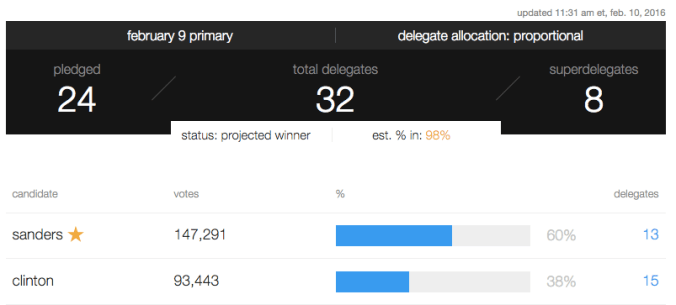
Bernie Sanders scored an impressive victory in the New Hampshire Democratic Primary last night, racking up a colossal 60% of the vote to Hillary Clinton’s 38%. And while a Bernie win here is not a huge surprise, this margin of victory (+22) is significantly greater than the run-up polling predicted. He also won among Clinton’s target demographic groups like women and moderates. So Bernie voters understandably see the New Hampshire results as a ray of hope for the “revolution” platform.

Hillary won the delegate count

But if we step back from the raw vote percentages, it’s clear that the bigger winner was actually Hillary Clinton– for two main reasons. First, by virtue of a quirk in the primary system, Clinton ends up getting more DNC delegates from New Hampshire than Bernie does. This is because New Hampshire’s delegation to the DNC includes 8 so-called super-delegates, party officials who are free to vote for whomever they favor regardless of the popular vote in New Hampshire. Six of the eight super-delegates have pledged to support Clinton, while the other two remain uncommitted. Thus, despite a smashing win in the New Hampshire popular vote, Bernie claims only 13 of the state’s delegates to Hillary’s 15 – per CNN. And of course it’s the delegates that ultimately matter for the purposes of winning the nomination!

Screen Shot 2016-02-10 at 11.36.06 AM.png

So despite Bernie’s great achievement, Hillary – smooth operator that she is – still comes out ahead in the race for the Democratic nomination. And in the upcoming primaries in states like Nevada, South Carolina, and several other southern states, Clinton faces a much more congenial electorate. If Bernie can’t win the delegate tally in independent-minded, heavily white New Hampshire, it’s not clear that he has much of a shot at taking down the Clinton operation in the long haul of the primaries.

Hillary’s GOP opposition just got downgraded

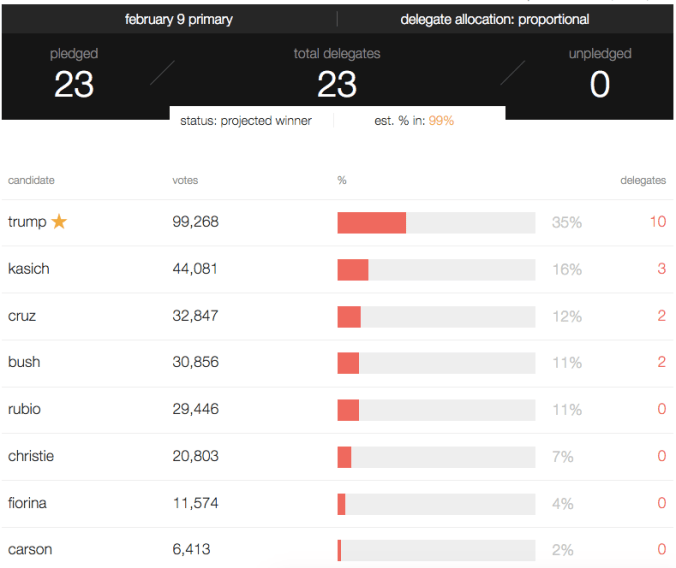
The second reason New Hampshire was a win for Hillary is arguably more important: it shows that the GOP is in shambles. After Rubiobot’s meltdown in Saturday’s debate, the so-called establishment lane of the GOP race went into chaos, with John Kasich emerging as the second place finisher in New Hampshire behind anti-establishment firebrand Trump.

Screen Shot 2016-02-10 at 11.57.11 AM.png

The problem for the GOP establishment/centrist bloc is that their support continues to be fragmented among Kasich, Rubio, Bush, and Christie. After Iowa it seemed that Rubio might emerge as the champion of this bloc who could challenge Trump and the more hard-right candidate Cruz. But with Rubio tumbling down to a sluggish fifth place finish, it seems more likely than ever the establishment will fail to unite, allowing Trump to divide and conquer and build unstoppable momentum as we head into the heart of primary season.

This is great news for Hillary. Trump has a net favorability rating of -20, and he fares poorly in head-to-head polls against Hillary. By comparison Rubio’s net favorables are -3.5 and he has the best head-to-head ratings against Hillary of any GOP candidate. (For reference, Hillary’s net favorability is around -11.) So Hillary should be delighted to see Trump rather than Rubio emerging as her likely opponent in the general election.

So I’d argue that for Hillary the most significant result of New Hampshire  was neither losing the popular vote nor winning the delegate count but rather watching her most dangerous rival on the GOP side fade to the middle of the pack.

New Hampshire Predictions: In the Wake of Rubiobot

Marco Rubio emerged from Iowa as the momentum candidate in the GOP. His strong third place finish put him close to Trump and decisively ahead of his “establishment” rivals: Bush, Kasich, and Christie. But then came Saturday’s debate and Rubio’s repetition gaffe:

Polls leading up to Saturday’s debate showed Rubio building toward a strong second place showing and another decisive win over his establishment peers, but now Rubio’s stock is dipping back toward the rest of the pack’s. Christie was eager to take down Rubio at the debate, but he came off looking like a bully and probably won’t get much of a bounce out of it. So the immediate beneficiaries of the Rubiobot moment are likely to be the other establishment lane figures: Kasich and Bush. With that in mind, it’s time for predictions for the GOP New Hampshire primary:

Trump: 32  Kasich: 15  Rubio: 14  Cruz: 12  Bush: 12 Christie: 8 Fiorina: 4  Carson: 2

If this plays out, the big picture winner here is also the immediate: Trump. Not only does Trump claim the lion’s share of the delegates but he also benefits from seeing an establishment lane that continues to be fractured and in flux. Will party elites rally around Kasich if he wins? Seems unlikely. But one could imagine them being slower to unify behind Rubio. Meanwhile unless Bush or Christie surprise, they will not have done enough to justify party confidence and might even need to think about exiting the race. If establishment support continues to be splintered among several candidates, Trump’s position will remain relatively strong as the campaign moves into the Southern states.

The Democratic side is much less intriguing in the Granite State. Expect a handy but not race-changing win for Bernie:

Sanders: 54  Clinton: 44